

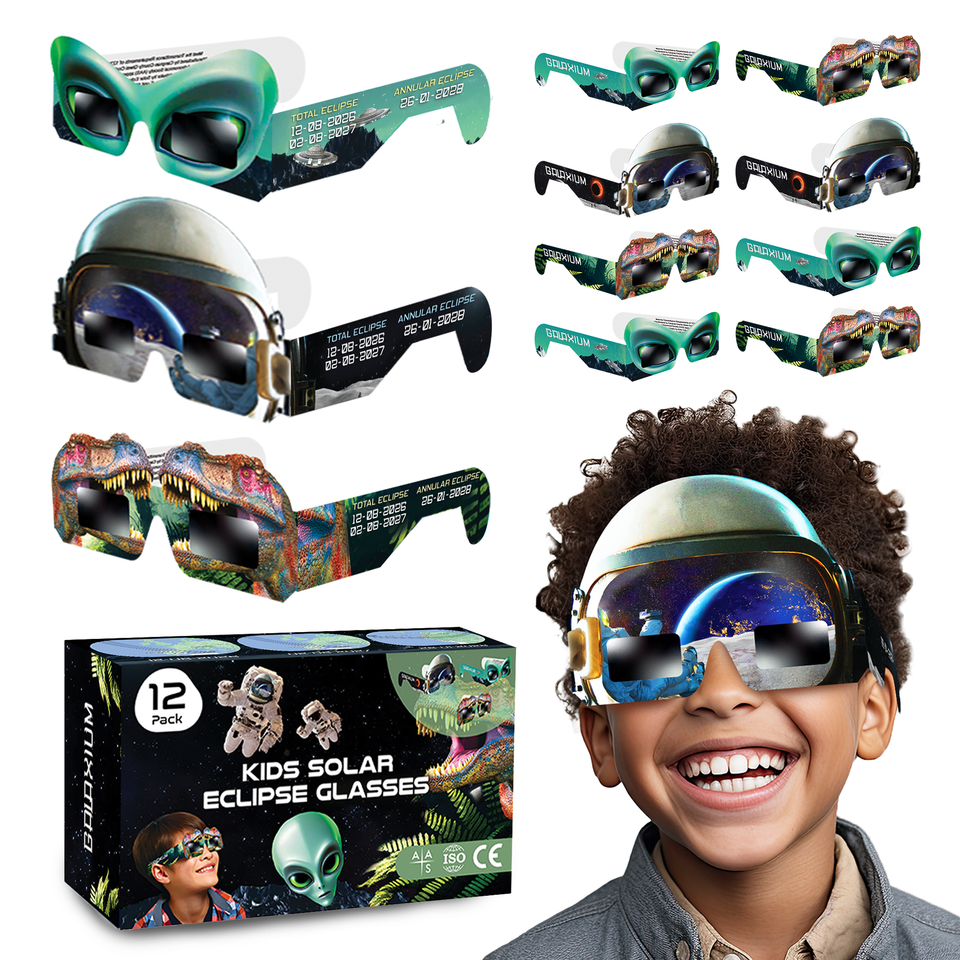
Adventure Edition Eclipse Glasses
Adventure-themed designs for young stargazers
Inside this 12-pack
What's included
- 12x ISO 12312-2 certified solar viewers for safe direct viewing of the Sun during partial and total eclipses.
- 3 alien, 3 astronaut and 3 dinosaur designs.
- CE marked for the European Union market.
- Each pair individually wrapped so filters stay scratch-free until use.
- E-book with viewing tips and eclipse timing reference.
- Recommended age: 5+
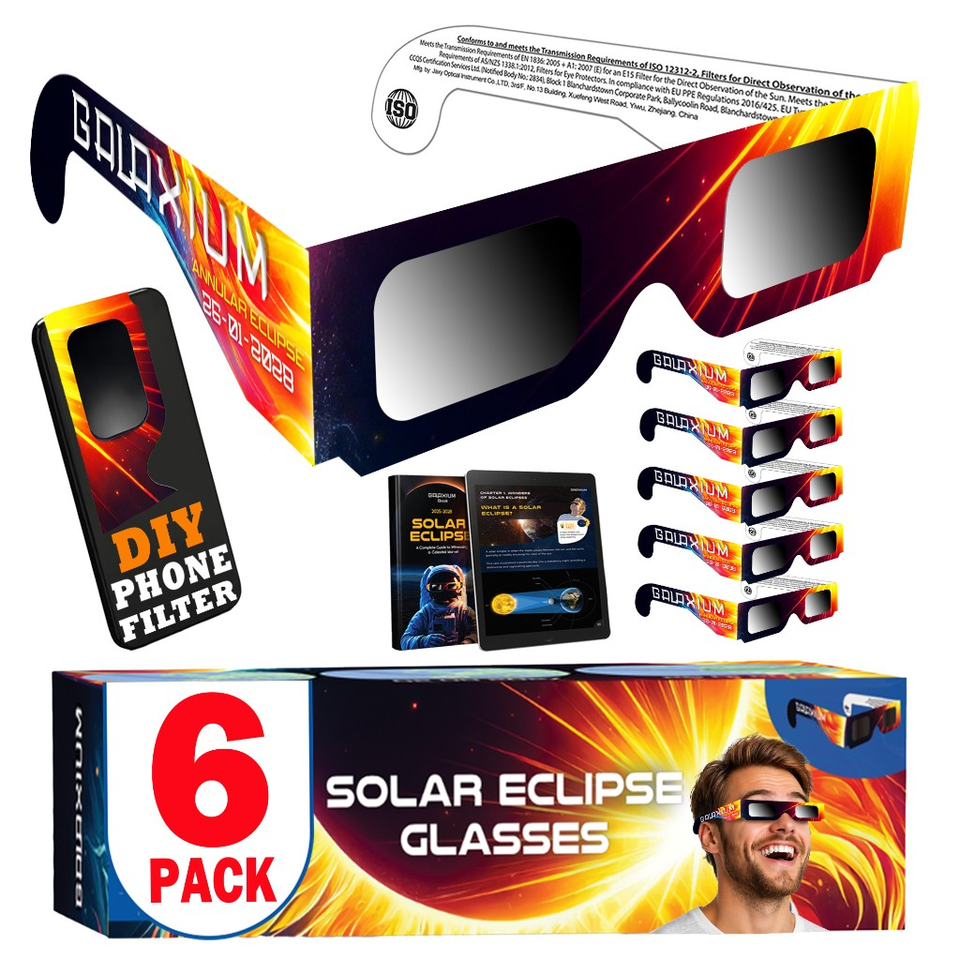
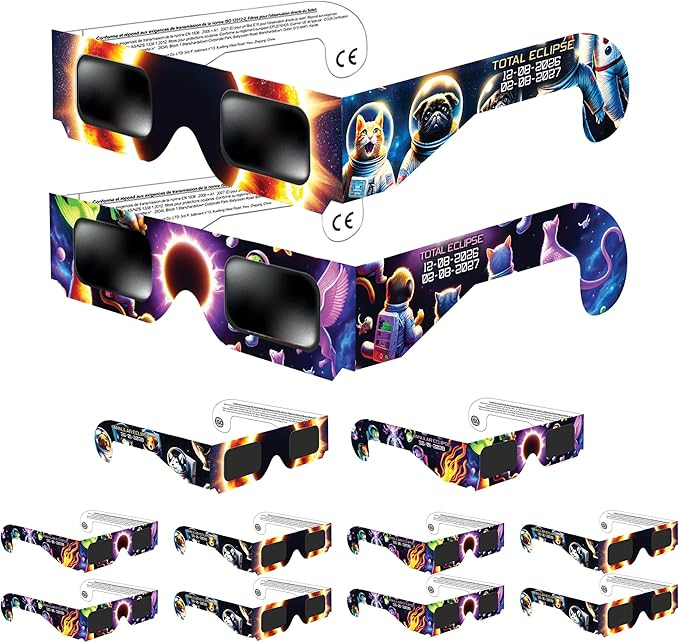
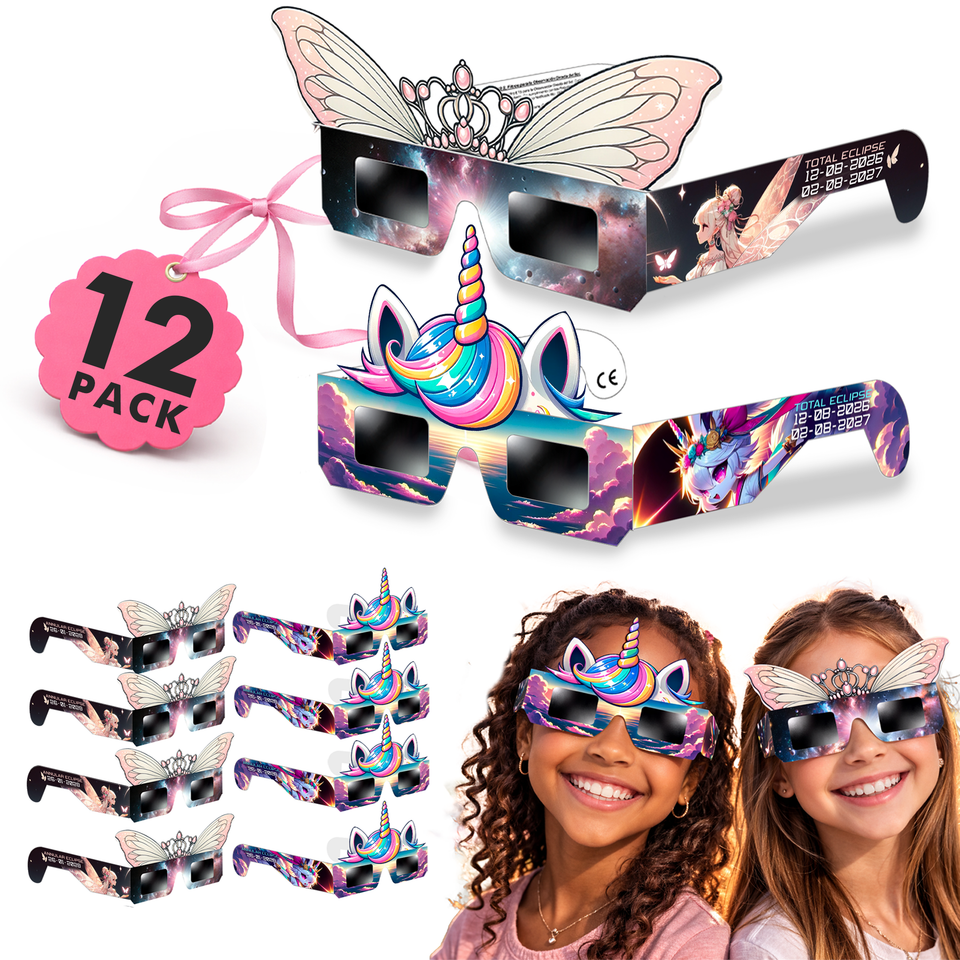
More from Galaxium
Frequently Asked Questions
Yes. Galaxium eclipse glasses are intended for direct observation of the Sun and meet ISO 12312-2 requirements for handheld solar viewers. They carry the CE mark for Europe and greatly reduce visible sunlight while blocking hazardous ultraviolet and infrared radiation.
Use them only as intended: never combine them with binoculars, telescopes, cameras, or phones - concentrated sunlight can destroy filters and cause instant eye injury. Inspect lenses before each use; discard any viewer that is scratched, punctured, or loose in the frame.
Wednesday 12 August 2026 - the Moon’s umbra crosses the Arctic, Greenland, Iceland, the Atlantic, northern Spain (including part of the Balearic area), and the western Mediterranean. NASA’s Fred Espenak eclipse predictions place maximum totality at about 2 minutes 18 seconds on the centre line (greatest duration is near the North Atlantic west of Iceland). Madrid and Barcelona are outside the narrow path; millions more people across Western Europe will see a deep partial eclipse and must use certified viewers for every partial phase.
Monday 2 August 2027 - totality begins over the Atlantic, crosses the Strait of Gibraltar region (parts of southern Spain, Morocco, Gibraltar), then sweeps across North Africa and the Middle East. NASA lists a greatest duration of about 6 minutes 23 seconds - among the longest totalities of the century - over southern Egypt. Always confirm exact local circumstances with an eclipse map or calculator for your coordinates.
ISO 12312-2 is the international standard for filters designed for naked-eye solar viewing; compliant viewers limit visible light and block harmful UV and IR. You cannot verify spectral transmission at home - that requires accredited laboratory instruments.
Buy from the manufacturer or an authorised reseller you trust. Inspect the product: reject scratched, warped, or loose filters. Astronomy organisations warn that fake ISO labels exist; a printed logo alone is not proof. If an online listing appears only at eclipse time with no traceable supplier, avoid it.
During every partial phase (before and after totality), you must wear ISO 12312-2 compliant glasses or use a compliant handheld viewer whenever any part of the bright solar disk is visible.
You may remove those viewers only during the brief total phase of a total solar eclipse, and only if you are standing inside the path where the Moon completely covers the Sun’s bright face. The instant the solar crescent reappears - third contact - put your glasses back on. If you are not in the path of totality, there is no safe naked-eye phase; keep your viewers on for the entire event.
A solar eclipse happens when the Moon passes between Earth and the Sun. In the narrow region where the Moon’s shadow cone (the umbra) touches Earth, the Moon can fully cover the Sun’s photosphere - a total solar eclipse. The sky darkens, bright stars and planets may appear, and the Sun’s outer atmosphere (the corona) becomes visible.
Over a much wider area the Moon covers only part of the Sun (a partial eclipse). The partial phases are never safe to observe without certified solar filters, because even a thin crescent Sun is intensely bright.
The 2026 path crosses northern Spain from the Atlantic toward the Mediterranean. Wikipedia and NASA mapping cite examples such as A Coruña, Bilbao, Zaragoza, Valencia, and Palma as locations where totality can be seen (exact duration and Sun altitude depend on your precise spot). Because the eclipse occurs in the evening for Spain, the Sun can be quite low - choose an unobstructed horizon and confirm local contact times.
Iceland and the Arctic segment of the path offer longer totality on the centre line but involve different travel and weather considerations. Wherever you go, partial phases always require certified eye protection.
The 2027 track is famous for long totality: NASA’s interactive maps show a greatest duration of roughly 6 minutes 23 seconds. The umbra crosses Gibraltar-area waters, Morocco, Algeria, Tunisia, Libya, Egypt, and onward into the Middle East - cities often quoted in predictions include Tangier, Tripoli, Benghazi, Luxor, and Jeddah.
Some popular Mediterranean destinations (for example Malta) lie outside the umbra and see only a deep partial eclipse. Check a detailed path map: being “close” is not enough - you must be inside the path to experience totality.
Book accommodation and transport early for high-demand corridors. Experienced eclipse chasers prioritise weather mobility: have a backup viewing location along the path and watch forecasts in the days beforehand - a shorter eclipse under clear skies beats a longer one behind clouds.
Arrive with viewers for everyone, practise wearing and removing glasses quickly, print or save local contact times, and bring water, sun protection for your skin, and (for photography) batteries and safe solar filters for optics. Joining an astronomy club or organised event can add briefing and crowd coordination.
NASA and eye-safety specialists emphasise that regular sunglasses - no matter how dark - transmit vastly too much visible light and may admit damaging infrared. Photographic neutral-density filters, crossed polarisers, smoked glass, CDs, and exposed colour film are equally unsafe for naked-eye solar viewing.
Solar eclipse viewers compliant with ISO 12312-2 are thousands of times darker than typical sunglasses. If a filter dims the Sun but leaks infrared, your retina can still be burned without immediate pain.
No. Looking through any optical instrument while wearing eclipse glasses concentrates heat and light and can crack the filter or injure your eyes instantly.
Cameras, binoculars, and telescopes need approved solar filters mounted securely over the front (objective) aperture - never improvised filters at the eyepiece. Phones pointed at the Sun can also be damaged without proper filtration. Consult equipment-specific guidance before attempting photography.
Yes, when adults supervise: help young children keep glasses flat against their faces and explain that they must not peek over or around them at the Sun.
Kid-sized designs make compliance easier; never leave children unattended with viewers during partial phases. One certified pair per child - sharing invites gaps and mistakes.
Use projection: punch a small hole in card and project the Sun’s image onto another surface, keeping your back to the Sun. You can also let sunlight filter through tree leaves to cast crescent images on the ground.
Never look at the Sun through the pinhole. Projection is safe for groups when nobody stares at the solar disk directly.
Allocate one ISO-compliant viewer per person for the entire partial phases. Schools, clubs, and employers should plan counts early - demand spikes before eclipse dates.
Galaxium sells multipacks (for example 6, 12, 25, 50, and 100). Contact us for larger wholesale orders.
Reuse is acceptable only if the lenses are undamaged and securely mounted; when in doubt, replace - cardboard frames age and adhesives can fail.
Eclipse glasses are not a substitute for sunglasses. They block almost all light and are meant for short, deliberate looks at the solar disk during eclipses - not for walking, driving, or routine outdoor wear.